




+86-13588556918
A feed mill that runs a grain intake line six days a week will push roughly 1,400 to 1,800 dump cycles through a single truck dumper in one quarter. Over those twelve weeks the hydraulic oil has been heated and cooled thousands of times, the pivot pins have carried the full weight of every trailer that rolled onto the platform, and the dust collection filter has loaded up with fines until airflow dropped enough to slow the discharge. Quarterly maintenance exists precisely because none of those three items fail on an annual timetable, and none of them will politely wait for the yearly shutdown to arrive.
The short version, before the detail: anchor quarterly maintenance to a fixed twelve-week or 500-operating-hour interval, give every quarter a written task list that matches your real duty cycle, and keep the fastest-moving parts on your own shelf rather than in a supplier's warehouse. Plants that work this way rarely lose a shift to an unplanned stop. Plants that treat quarterly maintenance as an oil change and a quick walk-around usually do.
This guide is written for maintenance managers, plant engineers and procurement teams responsible for truck dumpers, side-turn dumpers, container flipping machines and the conveying equipment behind them. It covers what belongs in a quarterly window, what can safely wait for the annual stop, how to plan the downtime, and how the equipment you buy in the first place decides how heavy that quarterly workload will be.
The core rule: quarterly maintenance is a schedule, not a mood. Fix the interval, fix the task list, and write down what you find every time.
Why a Twelve-Week Interval Fits Bulk Handling Equipment
Most maintenance schedules in bulk plants are inherited rather than designed. A dumper gets greased when the shift is quiet, a filter is changed when someone notices the airflow, and everything else is pushed into the annual shutdown. That approach survives until throughput rises, and then it stops working very quickly.
Three wear mechanisms set the real timetable on any unloading or container handling installation:
- Hydraulic oil degradation. Oil oxidises faster in hot, dusty environments, and the rate accelerates once contamination passes a certain level. In a two-shift operation, a dumper can accumulate 500 to 700 operating hours per quarter, which is often where additive packages begin to fall away measurably.
- Mechanical wear along the load path. Pivot pins, bushings, cylinder rod ends, structural welds and anchor bolts all take cyclic loads. Wear shows up in tenths of a millimetre first, then in vibration, then in a cracked weld or a snapped pin if nobody measured the early stage.
- Dust loading in the air path. Filters, ducting, pulse valves and discharge chutes lose efficiency gradually. A baghouse running at 70 percent of design airflow does not stop the line, it just slows every cycle and pushes dust into places it should never reach.
Each of these moves slowly enough that nothing fails in week three, and fast enough that by week twenty the machine is running outside its design envelope. A quarterly window catches all three while the correction is still a filter, a seal kit or a torque wrench. The annual window catches them when the correction is a cylinder, a platform section and a lost contract.
Quarterly maintenance is a measurement visit as much as a repair visit. If your team leaves without a number written down, the interval is not doing its job.
What Belongs in a Quarterly Maintenance Visit
A quarterly visit is not a cleaning visit and it is not a full overhaul. It sits in the middle: more invasive than a monthly check, far less disruptive than an annual teardown. The practical test for inclusion is simple. If an item can develop a measurable fault within roughly 500 operating hours, and that fault can be detected without dismantling the machine, it belongs in the quarterly list.
Hydraulic system tasks
- Draw an oil sample from the reservoir and check viscosity, water content and particle count against the oil supplier's limits.
- Inspect cylinder rods for scoring, pitting and seal weeping, particularly on the main lift cylinders where rod exposure is greatest.
- Replace the return-line filter element on schedule; on high-duty lines, inspect the breather and suction strainer at the same time.
- Check accumulator pre-charge where the circuit uses one, and record the reading so the next quarter has a baseline.
- Verify oil temperature under load against the commissioning record, and investigate any upward drift.
Structural and mechanical tasks
- Measure clearance or play at the platform pivot pins and bushing sets, and compare against the original specification.
- Torque-check the anchor bolts, cylinder mounting bolts and platform hinge bolts, using the values in the manual rather than a general rule of thumb.
- Inspect structural welds at the highest-stress locations, which on most dumpers are the hinge brackets, cylinder trunnions and the platform-to-frame transition.
- Check the alignment and clearance of guide rails, side rollers or clamping arms on side-turn and container machines.
- Examine the buffer or cushioning arrangement if the machine handles damage-sensitive cargo.
Control, safety and instrumentation tasks
- Test every limit switch, proximity sensor and interlock in sequence, not just the ones that trip most often.
- Inspect the electrical panel for loose terminals, discoloured wiring and dust accumulation, and use a thermal camera where one is available.
- Confirm emergency stops, anti-fall devices, guarding and audible warnings all function as designed.
- Back up PLC programs and parameter sets if anything has been adjusted since the last visit.
If an item cannot be measured or tested without major dismantling, leave it for the annual shutdown. Everything else that can drift within a quarter should be on the quarterly list.
The Quarterly Maintenance Task Matrix by Equipment Type
Different machines carry different quarterly priorities, and it helps to lay them side by side so the maintenance team and the production planner are working from the same document. The matrix below reflects what is typically done in plants running bulk intake and container handling equipment on one or two shifts per day. Adjust the durations to your own crew size, access conditions and how much of the work is outsourced.
| Equipment | Core quarterly tasks | Typical window | Usually performed by |
|---|---|---|---|
| Truck dumper, hydraulic side | Oil sampling, filter change, cylinder rod and seal inspection, accumulator check, hose and fitting survey | 4 to 6 hours | In-house maintenance team |
| Truck dumper, platform and frame | Pin and bushing clearance measurement, bolt torque check, weld inspection, platform alignment check | 4 to 8 hours | In-house with supplier support |
| Dust control system | Filter media inspection, pulse valve test, duct leakage check, fan and bearing lubrication | 3 to 5 hours | In-house maintenance team |
| Side-turn dumper | Lateral rotation mechanism inspection, guide roller clearance, sync system verification, safety interlock test | 5 to 8 hours | Supplier technician recommended |
| Mobile truck dumper | Travel gear inspection, brake test, tyre condition, steering and towing check plus all stationary tasks | 6 to 8 hours | In-house maintenance team |
| Container flipping machine | Twist lock inspection, clamping force check, tilt bearing lubrication, structural bolt torque check | 4 to 6 hours | In-house with supplier support |
| Integrated weighing system | Load cell check, zero and span verification, junction box inspection, calibration record update | 2 to 4 hours | Instrumentation specialist |
| Oat and grain process equipment | Screen and roller clearance check, belt tension, bearing lubrication, temperature sensor verification | 3 to 6 hours | In-house maintenance team |
The durations are planning figures, not guarantees, and they assume the plant has already staged the spare parts. A hydraulic filter change that normally takes forty minutes can consume half a shift if the element has to be collected from a supplier in another city.
Build the matrix once, review it once a year, and attach it to the work order every quarter. Written scope is what separates planned maintenance from improvisation.
Quarterly Maintenance on Truck Dumpers: The Tasks That Matter Most
On a truck dumper the quarterly visit lives or dies on three areas: the hydraulic power unit, the platform load path and the control interlocks. Everything else can usually wait.
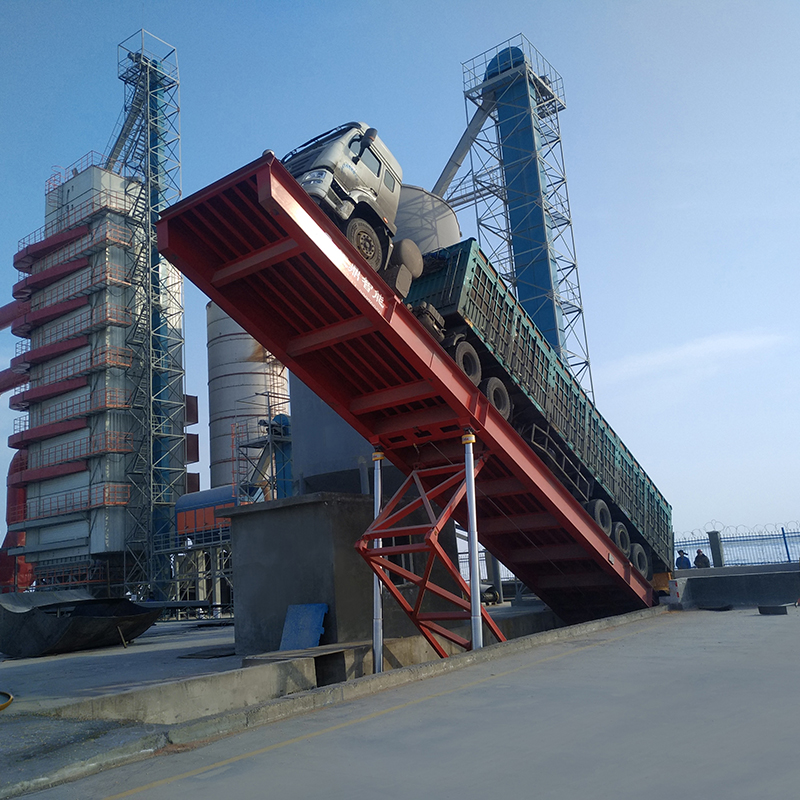 Truck DumpersWhile traditional truck dumpers synchronize side cylinders by controlling oil flow—a method prone to high failure rates and low precision—our system utilizes a mechani...View Product →
The hydraulic power unit deserves the most attention because it is the hardest item to repair under pressure. Oil that is sampled every quarter gives you a trend line, and a trend line is what lets you plan a full oil change during a scheduled stop rather than discovering contamination after a pump seizure. On machines handling dusty cargo such as coal, cement clinker or grain dust, the return filter and breather should be treated as consumables with a fixed quarterly replacement, not as items to inspect and hope.
The platform load path is where a quarterly measurement pays for itself several times over. Pivot pin clearance on a dumper that has handled 1,500 cycles is a real number, and comparing it to the commissioning value tells you how fast the bushings are wearing. The same logic applies to bolt torque at the cylinder trunnions and hinge brackets, where vibration and thermal cycling both loosen fasteners over time. A fifteen-minute torque check is cheap; a platform that shifts under load is not.
Control interlocks are the third leg. Limit switches on the platform position, the wheel stops, the entry gate and the discharge chute all protect operators and equipment. Testing them in sequence every quarter keeps the logic honest and catches the sensors that have drifted rather than failed. On unattended or partially automated installations, one sluggish sensor can put the whole sequence into a fault loop that looks like a software problem but is actually a mechanical one.
Measure pin clearance, torque the trunnion bolts, and test every interlock in sequence. Those three habits prevent the majority of dumper breakdowns that reach the production meeting.
Where the Quarterly Maintenance Hours Actually Go
Maintenance budgets are usually argued over in total hours, but the useful conversation is about distribution. Knowing which subsystem eats the time helps you decide where to invest in design changes, spares stock and training. The chart below shows a typical split on a bulk intake line running a standard truck dumper with dust control and weighing.
Share of quarterly maintenance labour hours by subsystem
Hydraulic power unit, cylinders and seals - 32%
Platform structure, pins and bushings - 24%
Dust control and air path - 16%
Control system, sensors and interlocks - 15%
Weighing and data calibration - 13%
The hydraulic share is large mainly because oil sampling, filter changes and cylinder inspection all sit in the same subsystem, and because a single leaking rod seal can add hours to a visit that was otherwise routine. Structural work follows closely behind, driven by pin measurement and torque verification rather than by repairs.
What the chart does not show is how much the equipment configuration shifts these proportions. A machine fitted with a full enclosure and an integrated dust control system moves a meaningful chunk of time into the air path, but it also keeps abrasive dust off the hydraulic rods and pins, which tends to reduce the two largest bars over the life of the machine.
Similarly, a dumper with an integrated weighing system adds calibration work to the quarterly list, but it also gives the maintenance team a cycle count and a tonnage figure that make interval planning far more accurate than a calendar guess. When you can see that a unit has handled 2,300 cycles instead of 1,500, you know which visit needs the extra hour.
Roughly half of a quarterly visit goes into hydraulics and structure, so that is where training, tooling and spares investment returns the most.
Side-Turn Dumpers, Mobile Units and Pitless Designs
Once you move away from the standard rear-tipping machine, the quarterly list needs additions rather than replacements. The core hydraulic and structural tasks stay the same; what changes is the mechanism around them.
Side-turn dumpers
A side-turn machine rotates the trailer laterally, which adds guide rollers, lateral cylinders and a synchronisation arrangement to the wear path. Quarterly attention should go to roller clearance, the alignment of the lateral guides and the condition of the synchronisation system, since any drift here tends to show up as uneven tyre or chassis loading rather than as an obvious mechanical fault. Automatic side-turn models add position sensing to the list, and those sensors should be tested through a full cycle rather than bench-checked in isolation.
Mobile truck dumpers
A mobile unit brings travel gear into the quarterly scope. Brakes, tyres, steering, towing points and the lifting or lowering arrangement for the working position all need checking alongside the stationary tasks. Since these machines are often moved between sites, the quarterly visit is also the right moment to confirm that the foundation or support surface at the current location is still level and capable of carrying the load.
Pitless and shallow-foundation designs
Machines designed to avoid deep civil works reduce construction cost, but they still need their own quarterly checks. The support structure, ramps and drive-on geometry carry the full load, so bolt torque, surface condition and drainage around the working area deserve attention. Water pooling under a shallow-foundation unit is a slow-acting problem that a quarterly inspection catches long before it reaches the steel.
Every special design feature adds one or two quarterly tasks. Write them into the schedule at commissioning, not after the first failure.
Quarterly Maintenance for Container Loading and Unloading Equipment
Container handling equipment has a different rhythm from bulk dumping. Cycles are fewer but heavier, and the failure modes cluster around clamping, locking and alignment rather than around abrasive dust.
 Container Flipping MachineThis equipment is a high-efficiency logistics apparatus specifically designed and manufactured for the automated loading and unloading of bulk materials in containers....View Product →
On a container flipping machine, the quarterly visit should verify twist lock engagement and wear, clamping arm force and travel, tilt bearing lubrication and the structural bolts that carry the rotating load. Twist locks are small components doing an enormous job, and a worn lock that still engages can pass a visual check while no longer holding the corner casting securely. Measuring wear rather than eyeballing it is the only reliable approach.
Container loaders and continuous handling systems add their own items: chain or belt tension, roller condition, alignment with the vehicle or rail position, and the accuracy of the positioning sensors that decide when the container is seated correctly. Where a gantry-style tilter is in use, the travel rails, drive units and end stops belong on the quarterly list as well, because a misaligned gantry puts torque into the frame every single cycle.
Because container equipment often runs intermittently, the temptation is to stretch the interval. That is usually the wrong call. A machine that sits idle between campaigns still suffers seal hardening, lubricant settling and corrosion on exposed surfaces, and it often returns to service at full load without any warm-up period. A fixed quarterly visit during the idle season is far cheaper than a repair during the peak.
Intermittent use is not lighter use. Container handling equipment needs the quarterly visit whether or not the line has been busy.
Process Equipment on the Same Site: Oat and Grain Lines
Plants that handle agricultural material often run unloading equipment alongside processing machinery, and it makes sense to schedule both in the same quarterly window so the production stop is shared. Oat dehullers, groats cutters and grain heating units each carry a short but specific task list.
On dehulling equipment, the quarterly focus is on rotor clearance, screen or perforated plate condition and the drive belt tension that decides how consistently the material is separated. On cutting equipment, blade or drum condition, clearance setting and bearing temperature are the items that matter, because a cutter running slightly out of tolerance produces inconsistent particle size long before it produces a breakdown. On heating units, burner condition, flame sensing, insulation integrity and temperature sensor verification keep the process stable and the energy bill predictable.
Grouping these machines into a single quarterly campaign also reduces the paperwork burden. One work order, one lockout procedure, one restart checklist. The maintenance team moves through the plant in a logical sequence instead of scattering visits across the calendar.
One quarterly stop covering unloading and processing equipment costs far less production time than three separate visits.
Planning the Quarterly Shutdown Window
A quarterly maintenance visit usually needs four to eight hours of machine downtime, or two to three days if structural work is included. Getting that window agreed in advance is a scheduling exercise, not a technical one, and it is where most quarterly programmes quietly fall apart.
- Publish the calendar twelve months ahead. Four dates, agreed with production, not negotiated the week before.
- Confirm the scope two weeks out. The task list becomes a work order with parts, tools and permits attached.
- Stage everything the day before. Filters, seals, torque wrenches, oil sampling bottles, calibration equipment and lifting gear on site and checked.
- Apply lockout and permit procedures before anything is opened. This is not optional on a machine with stored hydraulic pressure and a raised platform.
- Sequence the work from heaviest to lightest. Hydraulic and structural tasks first, while the crew is fresh and the machine is cool.
- Record findings before restart. Pin clearances, oil sample numbers, torque values and any faults found go into the equipment history.
- Run a full functional test before handing back. Every interlock, every limit switch, every emergency stop, through a complete cycle.
The restart test is the step most often shortened when production is pressing. It is also the step that prevents a machine returning to service with an interlock bypassed or a sensor left unplugged, which turns a planned four-hour stop into an unplanned twelve-hour one.
Agree the four dates a year in advance and treat them as fixed commitments. Quarterly maintenance fails on the calendar long before it fails in the workshop.
Spare Parts Strategy for Quarterly Maintenance
Quarterly maintenance is only as fast as the parts you already own. The distinction worth making is between consumables, which you should always hold, and insurance spares, which you hold because the lead time is unacceptable.
Consumables to keep on the shelf
- Hydraulic return and suction filter elements in the correct specification.
- Rod seals, wiper seals and O-ring kits for the cylinders actually installed.
- Dust collector filter media, pulse valve diaphragms and gaskets.
- Limit switches, proximity sensors and standard relays used in the control panel.
- Fasteners at the correct grade for trunnion, hinge and anchor connections.
- Grease and lubricants matched to the manufacturer's specification, not a general-purpose substitute.
Insurance spares worth holding
- One complete hydraulic pump or motor where the lead time exceeds a week.
- A spare set of pivot pins and bushings for the platform, sized to your machine.
- Load cells or weighing modules where the weighing system feeds invoicing or process control.
Buying through a specialised supplier or wholesale channel often reduces unit cost, but the more important variable is availability. A slightly higher price for a part that arrives in three days beats a discount on a part that arrives in six weeks. When selecting an equipment manufacturer, it is entirely reasonable to ask for a recommended spares list, typical lead times and whether consumables are standard catalogued items or proprietary components.
Ask about spares availability and lead times during the purchase negotiation, not during the first breakdown.
Weighing, Data and Condition Monitoring
An integrated weighing system is usually justified by throughput accounting, but it quietly changes how quarterly maintenance is planned. Once a machine records every cycle and every tonne, the maintenance interval stops being an estimate and becomes a calculation.
 Unattended Truck Dumpers With Integrated Weighing SystemThe equipment provides two functions: automatic unloading and automatic weighing, which effectively prevents measurement cheating, simplifies the vehicle unloading pro...View Product →
On an unattended dumper with integrated weighing, the quarterly visit gains a calibration step: zero verification, span check with a known load, junction box inspection and a written record. That work takes a couple of hours and keeps the weighing data trustworthy, which matters when the same figures are used to schedule the next maintenance visit.
The operational benefit is harder to overstate. If the data shows a machine handled 2,800 cycles in a quarter while its twin handled 1,600, the two units should not be on the same fixed task list. One gets the full quarterly scope, the other gets an inspection and a deferral, and the maintenance hours move to where the wear actually is.
Load cell drift is also easier to catch from data than from a spot check. A gradual shift in the zero reading over several weeks is a clear signal, and it usually appears long before an operator notices a discrepancy. Combining that trend with oil sample results gives a maintenance manager two independent indicators, which is considerably better than relying on either alone.
Cycle counts and tonnage turn quarterly maintenance from a calendar routine into a data-driven decision.
What Skipping Quarterly Maintenance Actually Costs
The cost of a quarterly visit is visible and easy to argue about. The cost of skipping it is spread across several budget lines, which is why it is so often underestimated.
- Lost production. An unplanned dumper stop during harvest or peak intake can idle an entire receiving line, including trucks waiting outside the gate.
- Secondary damage. A worn pin that is allowed to continue usually takes the bushing, the bracket and occasionally the platform section with it.
- Emergency labour. Night-shift callouts, express freight and contractor premiums often exceed the entire annual cost of the quarterly programme.
- Quality and compliance exposure. A drifting weighing system or a bypassed interlock creates documentation and safety problems that outlast the repair itself.
- Shortened equipment life. Machines maintained on a quarterly schedule routinely reach their design life; machines maintained reactively often do not.
A simple way to frame the decision is to compare the annual cost of four scheduled visits, including parts and lost production time, against the cost of a single unplanned failure. In most bulk plants the comparison is not close, particularly where the machine sits at the head of a receiving line and everything downstream depends on it.
Four planned visits almost always cost less than one unplanned failure at the head of a receiving line.
Buying Equipment With Quarterly Maintenance in Mind
How heavy your quarterly workload becomes is decided largely before the machine arrives. Access, component standardisation and documentation determine whether a visit takes four hours or eight, and whether it can be done in-house or needs a specialist.
When evaluating a manufacturer or supplier, the practical questions are straightforward. Are the lubricating points reachable without scaffolding? Are the hydraulic components standard catalogued items or proprietary parts with long lead times? Is there a clear service manual with torque values, clearances and interval tables? Does the supplier offer commissioning training that includes maintenance routines, and does it maintain a spares presence in your region?
Design details matter as much as commercial terms. Enclosed units with dedicated dust control keep abrasive material out of the hydraulic rods and pins, which reduces the two largest bars in the quarterly workload. Unattended designs with integrated weighing reduce manual intervention and provide the cycle data that makes interval planning accurate. Pitless and shallow-foundation models cut civil construction cost and simplify relocation, though they place a slightly higher premium on support surface inspection.
It is also worth asking who will support the machine in year five, not just year one. A wholesaler or trading intermediary may offer an attractive initial price, but the maintenance relationship that decides your long-term cost per tonne usually sits with the company that engineered and built the equipment. That is the relationship to test before signing, with specific questions about response time, remote support and the availability of wearing parts.
Access, standard parts and documentation decide your quarterly maintenance hours more than any single design feature.
Frequently Asked Questions About Quarterly Maintenance
How long should a quarterly maintenance stop take on a truck dumper?
For a standard machine in good condition, four to six hours covers hydraulic sampling, filter replacement, cylinder inspection, pin measurement, torque checks and interlock testing. Add two to four hours if structural work or platform alignment is included, and add travel time if the technician comes from outside. The first visit after commissioning usually takes longer because the baseline measurements still have to be recorded.
Can quarterly maintenance be performed in-house, or does it need the original manufacturer?
Most of it can be handled in-house if the plant has the manuals, the correct tooling and a trained maintenance team. Hydraulic oil analysis, filter changes, lubrication, torque checks and interlock testing are all standard industrial skills. Work on the synchronisation system, the weighing calibration or the control logic is usually better done with manufacturer support, either on site or remotely.
What should be replaced every quarter rather than simply inspected?
Return-line hydraulic filters, breather elements and dust collector consumables are the usual quarterly replacements, along with any seal that shows weeping. Pins, bushings, cylinders and pumps are inspected and measured, not replaced on a calendar. Replacing a healthy component too early wastes money; leaving a worn one in place wastes considerably more.
Does quarterly maintenance differ for a pitless or shallow-foundation truck dumper?
The machine-side tasks are the same. The difference is the surrounding structure. Support surfaces, approach ramps, anchor bolts and drainage need attention because there is no deep pit to contain spillage or water. Checking the surface level and the condition of the drive-on area every quarter is the practical addition.
How should quarterly maintenance be handled on equipment that runs only during seasonal campaigns?
Keep the quarterly interval and use the idle period for the work. Seals harden, lubricants settle and exposed surfaces corrode whether or not the machine is running. A visit during the off-season is also easier to schedule and gives the team time to correct anything found before the next campaign begins.
What records should be kept after each quarterly visit?
Oil sample results, filter and part numbers replaced, pin clearance measurements, torque values applied, calibration results, faults found and faults deferred. Photographs of any weld or structural observation are worth the thirty seconds they take. The value of the record is the trend across quarters, not the individual entry.
How does quarterly maintenance interact with annual inspections or certification?
They complement each other. Quarterly visits catch drift and wear while repairs are small, and they produce the measurement history that makes an annual inspection faster and more focused. An annual teardown with no quarterly data behind it starts by re-measuring everything from scratch, which is time the plant does not need to spend.
Keep the interval fixed, keep the records honest, and the annual inspection becomes a confirmation rather than an investigation.
Keeping the Quarterly Habit Alive
Quarterly maintenance survives on three things: a fixed date, a written scope and a record of what was found. Everything else, including which grease you use and which torque wrench you prefer, is detail that a competent team will sort out once the routine exists.
The plants that get the most out of a quarterly programme tend to be the ones that treat the fourth visit of the year as a review. They look at the four sets of measurements together, decide whether the interval should shorten for one particular machine, and adjust the spares stock accordingly. That is how a maintenance schedule becomes a maintenance system rather than a checklist that gets signed and filed.
If you are still specifying equipment and want the quarterly workload designed down rather than managed up, the details that matter are access, standard components and data. Those three factors decide whether your team spends its quarter measuring wear or chasing failures.
Explore more from our team
Quarterly maintenance is not an expense line. It is the cheapest insurance a bulk material handling plant can buy.


